Lincoln Square BID Requesting Proposals for Sanitation Services
The Lincoln Square Business Improvement District (LSBID) is seeking proposals from qualified firms through this request for proposals (RFP) to provide Sanitation Services and Area Maintenance to the LSBID. The RFP can be found by clicking here.
The LSBID will hold a pre-bid conference on Thursday, November 13, 2025 at 11:00 a.m. for those firms interested in submitting proposals. While not mandatory, the conference will give proposers the opportunity to ask questions. Please do not call the office, as individual questions will not be entertained prior to the pre-bid conference. If you plan on submitting a proposal and would like to attend the pre-bid conference, please RSVP by emailing Aquilino Cabral at acabral@lincolnsquarebid.org and Summer Smith at ssmith@lincolnsquarebid.org. Please provide your name, company name, and contact information when RSVPing. Only those who RSVP will be able to attend. Proposals are due no later than 5:00 p.m. on Friday, December 12, 2025. MWBE businesses are encouraged to apply. To learn more about the Lincoln Square BID, visit lincolnsquarebid.org.
Keep It Clean: Reminders About Commercial Trash Rules
The Lincoln Square BID is dedicated year-round to ensuring that the neighborhood is clean and litter-free. Seven days a week, the BID’s Clean Team diligently picks up litter, empties trash cans, removes graffiti and stickers, and more. The Clean Team also stores all the trash it collects in the BID’s eight Citibins—compact, rodent-proof containers—for collection by the NYC Department of Sanitation (DSNY), ensuring that no BID trash bags containing public litter are ever left on the sidewalk.
This work is important to making Lincoln Square a vibrant and hospitable neighborhood, but we cannot do it alone—the BID is not responsible for trash from the neighborhood’s businesses or residential buildings. Commercial and retail tenants are required to manage their own waste in compliance with all rules set by DSNY. While most businesses follow these regulations, some corporate businesses in the neighborhood may be willing to accept a fine rather than comply with the rules, which negatively impacts the neighborhood. Seeing trash bags on the sidewalk gives people the license to throw garbage on top of these piles, leading to more street litter and unsanitary conditions.
DSNY has specific rules for businesses, including hiring a private carter, keeping trash inside bins with secure lids, setting them out at specific times (one hour before closing or after 8:00pm), storing their bins inside their building or within three feet of the building line, and more. Businesses that miss pickups from their carter or experience other issues can contact the Business Integrity Commission. If the BID’s staff, Public Safety Officers, or Clean Team members see violations, such as trash set out improperly, they speak with the business and ask them to take the trash back inside. DSNY provides free resources and trainings, including information sessions and downloadable materials, to assist businesses in meeting these requirements, preventing waste, and avoiding common violations. Businesses can use this form to contact DSNY’s Bureau of Commercial Waste with questions.
Let’s all do our part to ensure Lincoln Square is kept clean!
Photo credit: BID Staff
What Ever Happened to… Lincoln Square’s Anti-Rat Trash Containers?
By Scott Etkin
While we wait to see whether the city’s composting and containerization programs can successfully reduce New York’s rat population (by isolating food scraps and other trash in rat-proof containers), it’s worth a look at how another city experiment is faring at keeping rats at bay.
In 2022, the Lincoln Square Business Improvement District – which roughly covers West 58th to 70th Street – began participating in a pilot program known as “Clean Curbs,” aimed at reducing litter from sidewalk trash receptacles on many Upper West Side street corners. The waste in these containers is what’s thrown out by the public when they’re on the street – making it separate from the residential and commercial trash targeted by the composting and containerization programs. The city, not residents or businesses, is responsible for these street containers, which can overflow, spilling onto sidewalks and attracting vermin.
Under the Clean Curbs program, receptacles in the UWS pilot area are emptied several times a day by the Lincoln Square BID, and the contents are then stored in locked, rat-proof containers, to be collected by the city’s Department of Sanitation. A West Side Rag article on the initiative from shortly after it started generated a vigorous 65 comments – expressing everything from deep skepticism that it would be effective, to enthusiastic optimism that the containers (rectangular metal boxes placed in street parking spaces) would make a real difference.
So, how has the program turned out? And does the BID’s experiment offer any hope for a rat-free neighborhood?
More than two years into the experiment, it has been scaled up. An additional four containers have been added to the West 60s, bringing the total number of bins to six. That may not sound like a lot, but some 300 bags of trash are deposited in those six bins every day. The bags put there are collected by BID’s “Clean Team,” 15 contracted maintenance workers who empty receptacles and sweep up the public’s trash throughout the neighborhood every day from 7 a.m. to 8 p.m. (9 p.m. on the weekends).
“Getting garbage bags off the sidewalks is really terrific,” said Monica Blum, president of the Lincoln Square BID, on a call with the Rag. But Blum acknowledges the system isn’t perfect yet. On holidays, for example, when there are no pick-ups, the bags from street corner receptacles end up on the sidewalk, and not in the metal boxes, she said.
And because transferring the full bags of trash to the metal bins is no small task, figuring out the tools the Clean Team needed for the job took some learning, Blum said. Some Clean Team members are now equipped with tandem rolling trash barrels so they can more easily move collected trash bags before bringing them to the stationary containers.
Another lesson the BID learned is how to keep the bins clean of the liquid that inevitably seeps out of garbage bags. The Clean Team power-washes the bins, inside and out, once a week. “The maintenance of them is key, but it’s also time-consuming,” said Ralph Memoli, executive vice president of the BID.
The bins appear clean enough that Blum has spotted people sitting on them to eat lunch.
Underneath the bins is another story, which the BID discovered when an unlucky tourist from Canada dropped an earbud below a bin. The BID helped him fish it out, but the experience led to a new policy: electric leaf blowers are used once a week to clear gunk and leaves from under the bins.
While a concern when the program began was that the bins took up spaces used for parking cars, the BID said it has not received any complaints about this from the community. The bins are about the size of one parking space. In some cases, they are located on a corner, which prevents a car from taking a sharp turn through the intersection, a safety practice known as “daylighting.”
Unlike the trash containers on wheels used by businesses and small residential buildings, the bins used by the BID are stationary and locked when not in use. Blum is hoping that they do not have to be replaced once the sanitation department starts using sideloading bins – which can be emptied using a lever attached to the truck – in the coming years; the BID doesn’t have the funding to replace the existing ones, she said. Plus, she believes the current bins have been effective.
“We don’t see rats, but there are some rats in our Broadway Malls in the flower beds,” said Blum. “We’ll see how many tulip bulbs get eaten this year.”
The fight continues.
Lincoln Square’s New Bins Put Trash Where Rats Can’t Reach
By Scott Etkin, West Side Rag
A new addition to the West 60s is making the neighborhood less hospitable to those four-legged, scurrying scavengers who usually make a meal of our leftovers.
The Lincoln Square Business Improvement District (BID), a nonprofit spanning W. 71st Street to W. 58th Street along Broadway, is using specialized bins to store garbage bags that are normally piled up for collection on the sidewalk. The initiative is part of the New York City Department of Sanitation’s “Clean Curbs” pilot program, which was launched by Mayor Eric Adams this past April.
“Mountains of black trash bags have long been an eyesore on New York City sidewalks, and Clean Curbs is an effort to eliminate those mountains and give sidewalk space back to New York City residents,” Vincent Gragnani, press secretary at DSNY, wrote in a statement to WSR.
This strategy, known officially as “containerized waste” (i.e., putting trash in a box), is the first line of defense in the city’s fight against the dreaded R word. “Clean Curbs gives rats fewer opportunities to feed and will take back our streetscape,” Gragnani wrote.
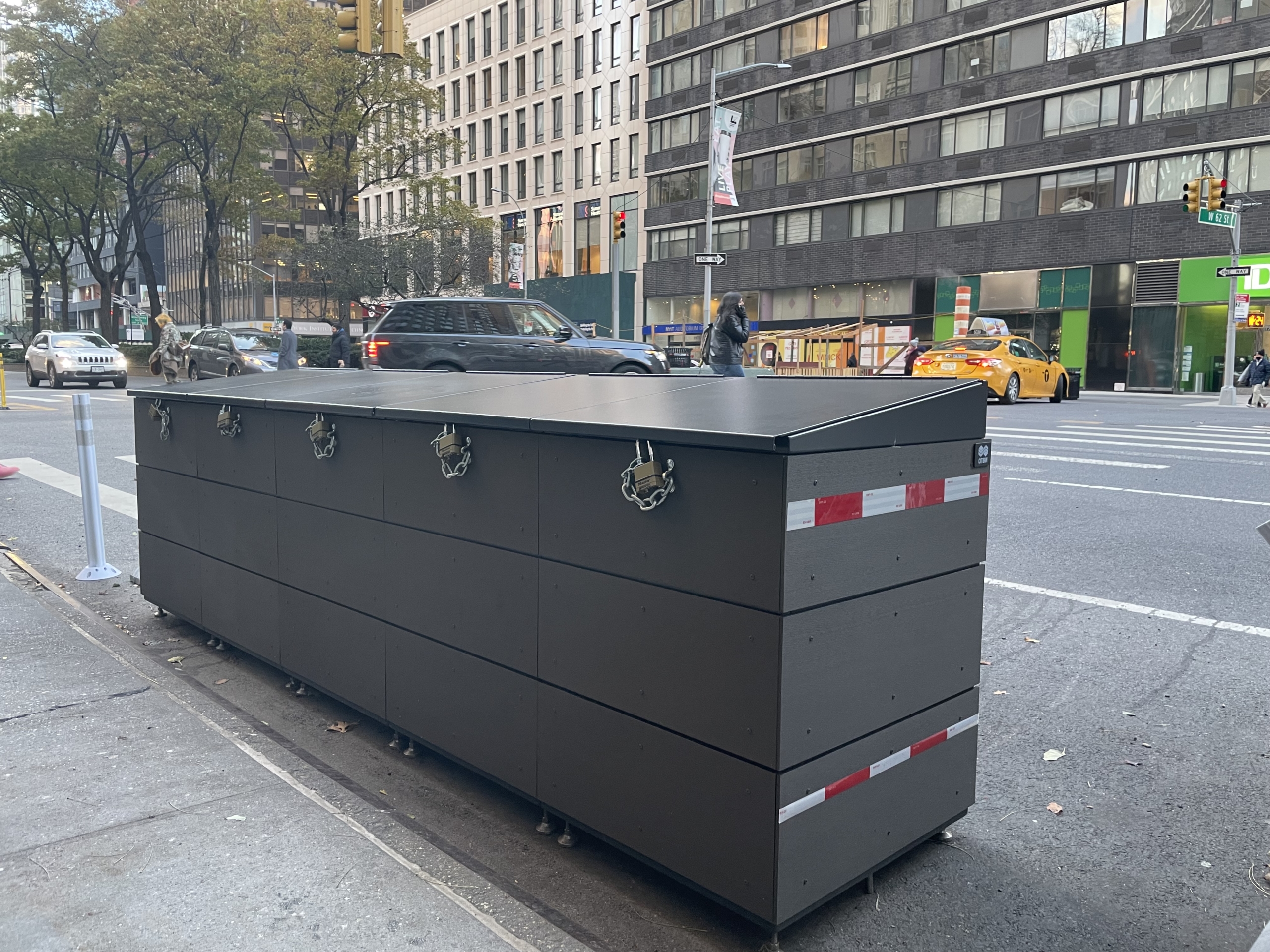
The Lincoln Square BID purchased two sets of five bins for two locations on the east and west sides of Broadway between 62nd and 63rd Streets. The bins are filled by the BID’s Clean Team, a maintenance crew that has 10 members working on any given day. DSNY trucks pick up the garbage on average twice per day.
“I’m a sanitation junkie,” said Monica Blum, president of the Lincoln Square BID. “I’m the type of person who goes nuts if our beautiful flower beds have one piece of litter in them.”
Since their debut in mid-October, the bins have elicited little reaction from the public, according to Blum. The bins are dark brown, about waist high, and have five sections, each secured with a padlock. There are small holes for liquid to drain out. Across both sites, the bins can all together hold approximately 40 bags of garbage.
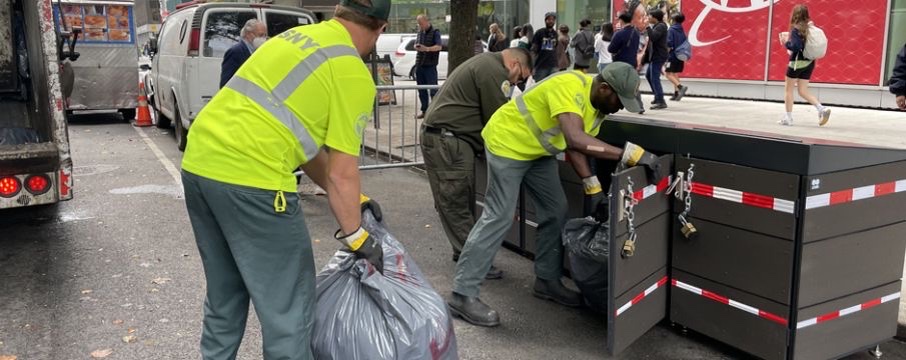
Lincoln Square is among the first neighborhoods – along with Brooklyn Heights, Brownsville, Stapleton, Times Square and Union Square – to participate in the Clean Curbs pilot. The application process was easy, Blum said. “The hardest part was getting siting approval from the Department of Transportation,” which mandates that the bins are off the sidewalk, but not interfering with any standing zones, fire hydrants, etc. The BID was reimbursed for the cost of the bins ($13,000), and they spent another $5,000 implementing the program, she said.
The BID opted to go with bins that are smaller and darker, after seeing how dirty the lighter-colored ones could get. “I think for us it’s much better to have small ones, because they’re just less imposing. They fit in less than a parking space,” said Blum. “I think they’re cute.”
Lincoln Square BID signed a two-year maintenance agreement with DSNY, and there are a few other locations in the neighborhood that the BID would like to use bins if the City expands the program. “We have been clear that if containerization were easy, it would have been done by now. It isn’t, but we are committed to moving forward with expansion,” wrote Gragnani.
“Bottom line is there are no bags on the corners anymore,” Blum said. “So it’s great!”